

Black pepper first arrived in Europe from its native southeast Asia over 3,000 years ago and has been cultivated and traded between empires, countries and companies ever since. It’s used in kitchens across the world, in a huge range of savoury and sweet dishes and is still the world’s most traded spice.
And yes, black pepper most definitely a spice. The next time someone walks past our stand at a food fair and says “yuk, I don’t do spices”, remind me to mutter quietly “Of course you do. Pepper!” ?
Anyway, here are five things you may not know about black pepper, plus a great curry recipe for those of you with this fine spice in your kitchen cupboard.
Black pepper actually starts off green
Black peppercorns come from a climbing vine (Piper nigrum) which grows in the tropics and can reach up to 7m high! Unlike white peppercorns which come from ripe red berries, black peppercorns are picked as unripe green berries and then left to ferment for several days before drying.
Black pepper is not as hot as white
The wonderfully antiquated book, Cooking for Bachelors, lists ordinary white pepper as ‘the most useful and usual form, good for table and cooking’ but recommends black pepper ‘if you are fond of flavour’! We’d probably debate the ‘most useful’ bit but black pepper does have more flavour and perfume than white. White pepper is sharper and hotter but lacks the pungent flavour of black.
Black pepper doesn’t just taste good
Black pepper has a long history of medicinal uses, thanks to its chemical compound piperine (which also gives it its heat). The long list of benefits includes antioxidant properties, improving digestion and reducing stress levels. We’re off to get grinding ?
It’s been used for much more than just cooking
During the civil war of 1139-53, black peppercorns were often used to pay rents as coins were scarce and unlike silver, peppercorns could not be debased. In the Middle Ages, black pepper was again accepted as currency and it was used to pay taxes and rent right through to the 18th century. By the 19th century however, its price had fallen and the term ‘peppercorn rent’, which we still use today, came to mean a low or very nominal rent.
It wasn’t always £1.60 a jar in your local supermarket!
In Roman times, black pepper was the most expensive of all spices and in 1668, the price of a pound of pepper in London was 16s 8d when average weekly earnings for a labourer were 5s!
Fortunately black pepper no longer costs 3 times your weekly salary, so check out this great curry recipe. It’s a current favourite in our household and a delicious way to use up any leftover veg. We’ve included a selection of veg here, but you could switch these for whatever veg you fancy. We’d just recommend keeping the overall weight the same, or at least very similar. We’ve used a Basket of Fire chilli, but you might prefer to use something a little milder, or a little hotter! We’ve also made it with Cayenne chilli paste from Goch & Company. Both worked really well.
Recipe for Cashew Nut and Black Pepper Curry
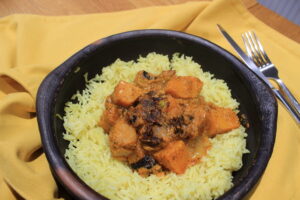
Ingredients (serves 2)
3 tbsp nut oil
30g fresh coriander (or 3g dried)
1/8 tsp green cardamom seeds
1 red chilli deseeded (or 1-2 tsp chilli paste)
40g fresh ginger roughly chopped
20g garlic (about 6 cloves) peeled
1 tsp coarse black pepper
½ tsp sea salt (optional – it may already be in your chilli paste)
2 heaped tbsp (40g) tomato puree
1 tbsp sugar or honey (again check, they may already be in your paste)
1 tbsp lemon juice
50g cashew nuts
150g onion (1 medium-sized) roughly chopped
250g butternut squash cut into 2cm chunks
75g carrots cut into 1cm pieces
250ml vegetable stock
50g frozen sweetcorn
Instructions
- Blend 2 tbsp of the oil, the coriander, cardamom seeds, chilli, ginger, garlic, black pepper, salt, tomato puree, sugar, lemon juice and cashews in a blender cup until the mixture is smooth. Set aside until needed.
- Add the remaining tbsp of oil to a large frying pan on a low to medium heat. Add the onions and gently fry for 5 minutes, or until soft. Add the squash and carrots and fry for another 5 minutes, stirring frequently.
- Add in your paste and mix well with the vegetables. Slowly stir in the stock until fully dissolved with the mixture. Bring to the boil, then cover with a lid and simmer for 20 minutes.
- Remove the lid, add the sweetcorn and cook for a further 10 minutes, before serving with rice or naan bread.
Sources:
A curious history of food and drink (Ian Crofton), The Herb and Spice Companion (Webb/Craze), Cooking for Bachelors and Bachelor Girls (Patten), The Hungry Empire (Collingham), The Science of Spice (Farrimond), Kitchen Herbs & Spices (Lanska/Hlava), Herbs & Spices (Norman).